
Arbors
The repair does not retrace what was lost.

Last time I told you I had to look up how many times a catheter had been inside my own heart.
I said five for years. It was six.
I moved past that too quickly. It is the part I get asked about least and think about most, so I am going to stay there a while.
The question
It starts as a question from somebody who loves you.
Do you remember?
And you don’t.
Not it’s on the tip of my tongue. Not give me a second. There is no tongue and no tip. You reach for the place the thing should be and your hand closes on nothing - and the strange part is that the nothing has no edges. You cannot feel the shape of what is missing. You cannot tell how big it is.
Then you have to say something out loud, and every available sentence is wrong.
Say I don’t remember and it sounds like you weren’t paying attention. Say that never happened and now you have called them a liar. Say nothing and you are being cold about something that mattered to them.
There is no correct sentence. I have been looking for it for years.
What it does to the room
For them it is frustrating. I understand that completely. If you tell someone about a day you shared and they give you a polite blank face, that is a small injury. It repeats. It accumulates.
For me it is frightening in a way I have never once managed to explain in the moment.
Because the question is never really do you remember the trip. The question underneath it is how much of you is still in there - and I do not know. I cannot audit it. There is no index. The only way I find out something is gone is when somebody reaches for it and it isn’t there.
You discover the holes by falling into them. In front of people. Usually at dinner.
And by the time you have found language for any of it, the moment has moved on and you are three sentences behind, and the person across from you has already decided what your face meant.
Uncharted
I wrote last time about standing inside a statistic that was completely accurate and did not describe me.
This is the other side of that. Out here, the honest answer to most questions is nobody knows.
Seven years. Six ablations. Anesthesia over and over. A right ventricle rewriting itself between appointments. Three million premature beats in a single year. High-dose sotalol for years. Three shocks from the pond.
Which one took the memory?
All of them. Some of them. I cannot tell you, and neither can anybody else, and I have stopped needing that answer more than I need the next thing.
Because it is the same deal the arrhythmia makes. You do not get a cure and you do not get an explanation. You get a thing you live with. You learn where it lives. You stop arguing with it. You go on.
That is the work.
It has been extraordinarily difficult, personally and professionally. Uncharted territory sounds romantic until you are the chart.
Arbor
My daughter’s name is Arbor.
Her mother and I are both from Michigan, and we named her for Ann Arbor. That was the reason. There wasn’t another one.
Arbor is Latin for tree. We did not pick it for that. We picked it for a city - and the city, as the story goes, was named for a stand of burr oaks and two settlers’ wives who were both called Ann. The tree was already inside the name before either of us got there. We didn’t put it in. We inherited it.
She was born March 21.
I have been calling that the equinox for years. Since I promised you I keep my promises about numbers, I checked it.
The astronomical equinox that year fell on the twentieth. By the sky’s count, she missed it by a day. Technically, she was supposed to arrive on the 20th, but at 11lbs and 7oz, she took her time making an entrance. She always does. Worth it.
March 21 is not an approximation. It is the appointed date. The Gregorian calendar was reformed in 1582 for the specific purpose of pinning the equinox back to March 21 so that Easter could be reliably computed, and the ecclesiastical equinox has been fixed there ever since.
She was not born on the equinox the sky observed. She was born on the one the world agreed to keep.
She is brilliant. I do not say that as her father. If you know me, you know this - I do not hand out merit where it is not due, to anyone, ever - it is earned, always. She earns it.
And when the days became nearly impossible, and I have been clear in all of this about how near, she is the reason I kept going.
Like from the movie Inception. The totem.
My root.
The other tree
This week I had a model draw me something.
Not the heart. The brain. I wanted to see what chronic stress does to a neuron, because the heart only tells half of this story and I have never believed the psychological side was a separate department from the electrical one.
The structure it drew is called a dendritic arbor.
That is the anatomical term. Arbor. The same word. Because the first people to look at a neuron saw a tree and had no better noun for it. There is a structure in the cerebellum that anatomists named arbor vitae - the tree of life - centuries ago, and nobody has bothered to rename it since.
So I named a daughter after a city named for oaks, and thirteen years later I was handed a picture of the branching structure that carries every signal I have, and the word for it was already her name.
What prunes and what proliferates
Under sustained stress, dendrites in the prefrontal cortex retract. Branch points are lost. The tree thins. In the hippocampus - memory - the same thing happens.
And in the amygdala, under identical conditions, it runs the other way. It grows.
Threat detection expands while executive control and contextual memory contract.
Two structures prune. One proliferates.
The brake and the accelerator are built out of the same material.
Where I stand
Nobody has looked at my brain. That remains true and I am not walking it back.
I also want to be precise about what is animal work and what is not, because I had it wrong in my own head at first, and the truth turned out to be better than I thought.
The morphology is animal. The dendrites themselves - branches counted, retraction measured in microns, regrowth tracked over weeks - comes from rodent work, because you cannot image a living human dendrite. That limitation is real.
The consequences are human. Prefrontal function degrading under sustained stress, and recovering when the load comes off, has been demonstrated in people. Structural change in the human hippocampus under chronic stress is documented. The functional signature exists in our species.
What we cannot do is open a skull and count branches.
So here is my position, labeled exactly as what it is.
I believe the mechanism holds across species. That is an opinion. It is an informed one, I will argue it with anybody, and it is not a finding. I refuse to dress it as one.
And here is what is not an opinion.
My arbors atrophied. I lived it.
They are coming back. I am living it.
I do not need a microscope to have standing on that. Nobody gets to tell me it did not happen because the instrument required to measure it has not been built. The absence of an instrument is not the absence of a phenomenon.
Kintsugi
Kintsugi is the Japanese practice of repairing broken pottery with gold. You do not hide the break. You fill it, and the repair becomes the most visible thing about the object, and the object is worth more afterward than it was before it broke.
When dendrites regrow after the load comes off - and they do regrow - they do not retrace the branches that were lost. The tree reaches similar function through different geometry.
It does not come back the same.
It comes back.
So I had it drawn in black and gold. The surviving arbor in one tone, the regrown branches lit like seams.
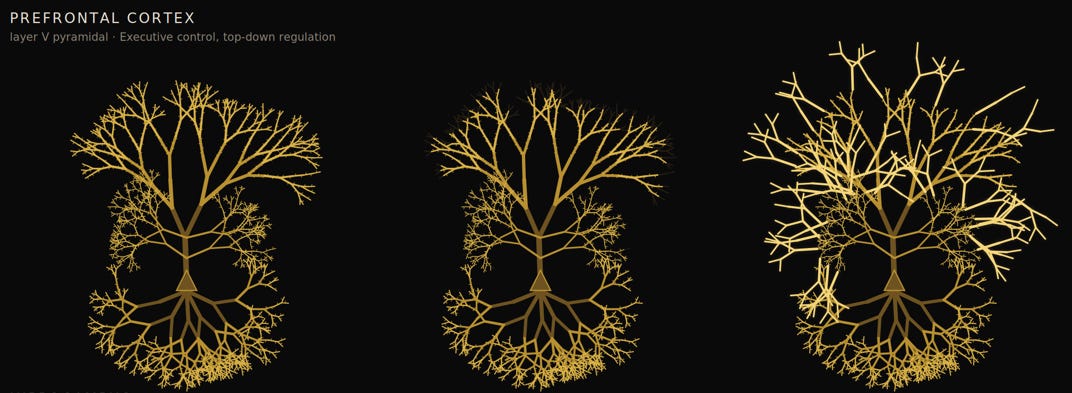
I looked at it for a long time.
The numbers
I am not going to tell you the numbers in my life mean something.
Three shocks at the pond. Three years to the day between that afternoon and the last ablation. Thirty-three lesions. Ninety days between the implant and the first shock, which is one season, almost exactly.
Numbers confess to anything under pressure. I could keep going all night and it would prove nothing except that I went looking.
December 9 came around three times. On the third one I went back to the lab and let them try again with an energy that did not exist when this started.
Gratitude
Vague gratitude is noise. I’ll be specific.
To the researchers whose work I have been pouring over these past few months: I am a patient with no laboratory and no credentials in your field, and I found my own experience described in your papers with more precision than I have ever managed myself.
Bruce McEwen spent a career establishing that stress is not a mood. It is a load, and loads remodel tissue. He died in 2020. I never met him and I owe him a great deal.
The people who did the slow work of measuring what sustained stress does to the architecture of a brain - over years, in labs, for an audience that was never going to include me - handed me the only language I have found that fits.
I did not know that language previously.
That is what research is for. Somebody you will never meet, decades later, in a bad stretch, finding the sentence that finally explains him to himself.
There are many others to name. They will be.
On the tools
I build with AI. I love it.
I will talk more about this in a future article. I have many thoughts. Too many. That will come later.
Here is what AI did and did not do to help me in this pursuit.
It did not find the pattern. It did not pull my records, sit with those reports, or walk back into that room on December 9. It did not raise my daughter, and it did not give her the name.
What it did was let a man with no laboratory, no research training, and a compromised memory cross a literature that would otherwise have taken him years - and hold enough of it in one place, at one time, to see the shape.
For seven years the thing I could not do was assemble my own experience into anything legible. That is precisely the capacity this disease took from me.
I got some of it back through a tool.
So: I am going to leave all the other thoughts on AI alone. I am going to recognize AI for what it is – a tool. I am thankful to Anthropic for building a tool that helped give me some of that capacity back.
The hand
I lost years. That is real, and as far as anyone can tell me it is permanent. It has cost me. It is frightening.
But here is the other side.
I got sharper at the only thing I was ever really good at.
Reasoning.
You play the hand you are dealt. Everybody says that. Almost nobody means the second half of it - that the hand is not a verdict. It is inventory. You count what you actually hold instead of what you wish you held, and then you play it like it is the winning hand, because playing it that way is the only way to find out.
I struggle to remember the most formative years of my child’s life, because an extreme amount of that time was filled with my heart sending signals to my brain that there might be other priorities.
Vision? I can see, faster than I ever have in my life. Pretty good timing for that if I am honest.
The reality is blunt.
I am never getting that time back. Those memories are not coming back because the facts are that they never encoded properly in the first place. That wasn’t because of a character flaw. It was the fight of my life.
So, I have a hand.
And in that hand are my aces. My vision.
And I will win the hand.
To everyone whose heart beats wrong
You must not lose hope.
I am not saying that from a comfortable chair.
I lost mine. Entirely. There was a stretch where hope was simply not in the room. That article will come later.
Hope came back.
It did not come back the way it left. Nothing does. It came back through different geometry - which is the thing I have spent this entire piece trying to say.
So if you are somewhere in the middle of losing yours right now, understand what that is. It is not the end of the story. It is a chapter. And I am sitting here as one data point of exactly one, telling you that chapter ends.
I lost it.
It came back.
- Matthew J. Adams
ad astra per aspera