
Life in the 0.1%
Performance not typical. It is the mandate.

I was born at Sparrow Hospital in Lansing, Michigan.
Some have said the sparrow is of no value. Somehow the ledger always gets corrected on that.
That has been the story of my life.
Six
I had to look it up.
For years I told everyone five. Five ablations, two aborted. That is what I remembered, and I said it with confidence - to my doctors, to my family, to anyone who asked how bad it had been. Five and two. Clean number. Easy to say.
Then I pulled my records.
Six completed procedures. One aborted. And the one I had lost was the one performed the same day they put a defibrillator in my chest.
I could not remember how many times a catheter had been inside my own heart.
I am a person who is rather neurotic about data. I am precise about numbers on purpose. And somewhere in seven years I dropped an entire operation - the sedation, the groin puncture, the drive home - out of my own account of my own life, and I never noticed, because nobody around me was counting either.
That is what the years did.
The 0.1%
Here is the context, since I promised numbers and I keep my promises about numbers.
For most people with the arrhythmia I was diagnosed with, this is a short story. Premature ventricular contractions from the right ventricular outflow tract - the RVOT - are the friendly version. In the multicenter data, RVOT origin carries the highest ablation success rate of any location in the heart, around 93%. Long-term, roughly 80% of outflow tract patients are still doing fine at five years. You go in once. It works. You go home and get on with it.
Six times is not that story.
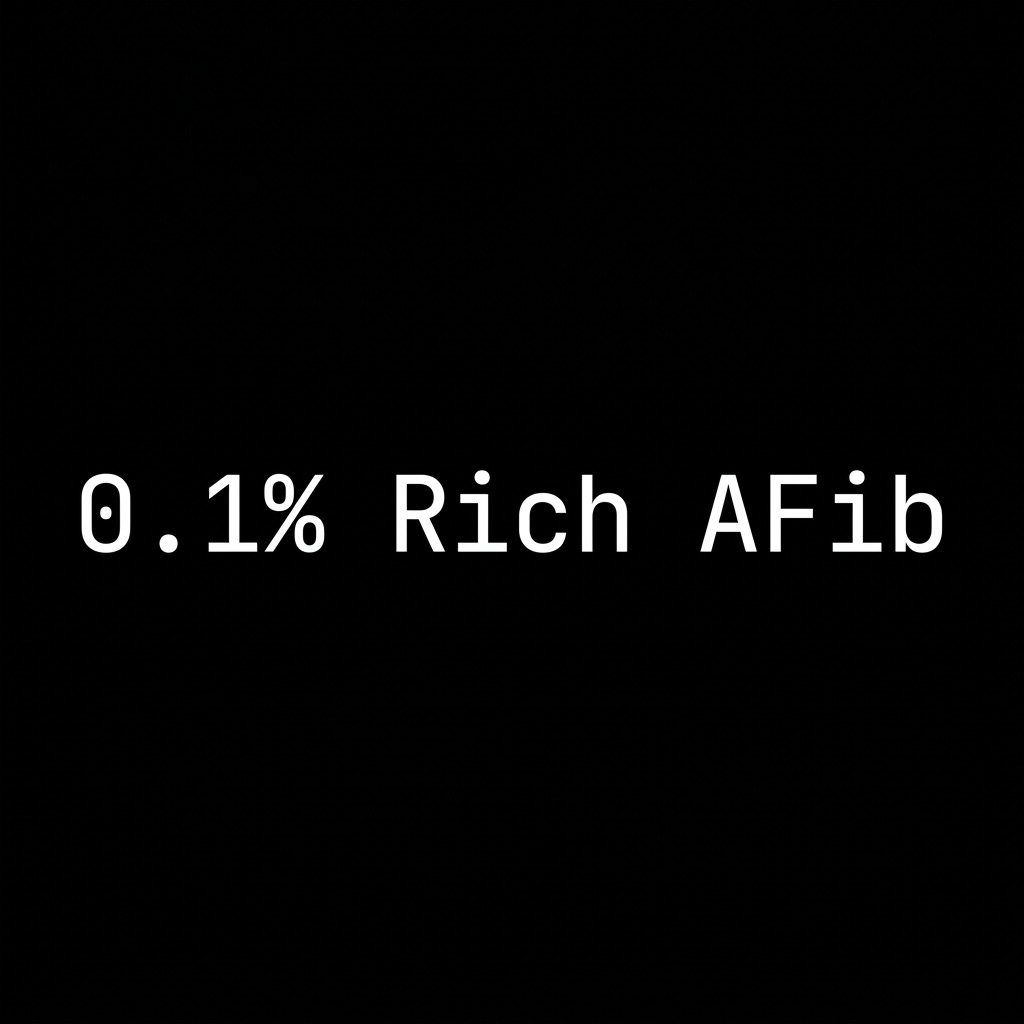
You might as well call me Rich AFib, because the ventricles were not the only problem along the way. And as a matter of patient preference, let me make one small observation: if you could order these à la carte, I am taking ventricles every time. The atrial route involves considerably more large needles. No likey. Worked like a charm, though. So there is that.
Now. As a citizen of the 0.1%, I can report that there are no tax advantages.
It does not matter how tired you are. It does not matter what room you are in or who needs you in it. You chew the pills and you keep going, because if anyone sees you break, you are cooked.
I say that with some authority. In hindsight I would far rather have been cooked earlier than fried later.
What the records actually say
August 3, 2017. Age thirty-one. First ablation. They found the focus in the posterior RVOT, burned it, and the exit site moved. Residual PVCs at the end of the case. I went home on propafenone and got on with it, because that is what you do when the diagnosis is the benign one.
April 19, 2021. I went to the emergency room with abdominal pain. A stomach ache. While I was there, someone noticed runs of ventricular tachycardia on the monitor.
That is how it got caught. Not by a system looking for it. By a stomach ache.
Three days later they put a patch on me. Over four days it recorded 235 episodes of ventricular tachycardia. The technician made a courtesy call to my electrophysiologist that evening. On the intake form, under heart disease, someone had written: None known.
I was clearing trees on our property when the call came. He told me to stop whatever I was doing.
April 27, 2021. Treadmill. Bruce protocol. Eleven minutes and six seconds, 203 beats per minute - 109% of my predicted maximum - before it went into sustained monomorphic ventricular tachycardia before it quit on its own.
I have written before that this was the day fear entered my life and never fully left. That is true. But I have been rereading the report, and there is another way to say it. I had been doing exactly that - pushing my heart to the top of its range, alone - for four years. April 27 was not the day it became dangerous. It was the first day it happened somewhere someone could catch me.
Both are true. I only ever wrote one of them down.
August 17, 2021. Cardiac MRI. My right ventricular ejection fraction came back at 44%. And in the free wall of my right ventricle, the radiologist described a microaneurysmal, accordion-like pattern - the wall moving out of time with itself.
He scored it against the published criteria for arrhythmogenic right ventricular cardiomyopathy. Minor criteria, met. Combined with sudden cardiac death in my family, that became the working diagnosis, and it has been the working diagnosis ever since.
September 10, 2021. Boston Scientific dual-chamber defibrillator, left chest.
The 93% was real. It just was not mine.
This is the part I need people to understand, because it is the whole reason I do what I do now.
Nobody was wrong. My 2017 tracing was textbook: left bundle morphology, inferior axis, transition at V4, a 98% pace map. That pattern is scored as the minor criterion in the cardiomyopathy guidelines for a specific reason - because it usually means the harmless thing. The very shape that made everyone comfortable is the shape the disease uses to look like nothing at all.
So for four years I stood inside a statistic that was completely accurate and did not describe me. The 93% was real. It belonged to somebody else.
And the disease moved while I was standing there. In April 2021 my monitor called the PVCs unifocal - one site, one origin. By January 2024 the operative note reads at least two different populations, including one arising from further down in the right ventricle, outside the outflow tract entirely.
The target kept moving because the substrate kept growing. Six procedures is not six failures. It is six correct operations performed on a heart that was rewriting itself between appointments.
Intermission for a fanboy kudos to the man and an unpaid shill for all the right reasons.
This vlog update from Garrett Clark really hit me. I have no shame and I will not hide it. I am a 40-year old bogey golfer with a battery in my chest that does not play well with the backswing - I found joy more often watching Good Good golf videos than actually being on the course.
I am glad to see him so open about it. That he talked about how frightening it can be. He is correct. It can be.
I am glad that he decided to take the time off that he needs to prioritize what matters.
Health is wealth.
It starts with our hearts.
And from GC - this was as rich as it gets.
GG golf is awesome. Watch it.
Any who, onwards.
The pond
December 9, 2021. Three months after the implant.
It was hot. I had not taken my morning medication. I was waist-deep off the shore of the pond on our property - the place I went specifically to stop thinking about my heart. That was the entire point of the pond.
I went into VT without noticing, because I was busy.
The first shock came before I understood what was happening. I panicked, got myself together, and started for the house. The second one put me on my knees. I got up yelling for help, and a pest control worker in the driveway saw me and ran inside for my family.
The third one, I stopped. I lay down in the dirt. I thought that was the end of it, and I remember lying on my back saying I was sorry, over and over, to no one in particular.
There is no operative note for that afternoon. There is no billing code. It exists only in my memory, which - as I have now established in writing - is not a reliable instrument.
Three years later to the day, on December 9, 2024, I had my last ablation. I have not decided what to do with that.
What stable looks like
I want to show you the last full year before it ended, because I do not trust my memory of it and I do not have to. The device kept its own records.
Two remote transmissions. June 17, 2024, covering the prior three months: twenty-four high atrial rate episodes and thirteen high ventricular rate episodes, ventricular rates ranging from 136 to 205 beats per minute. September 13, 2024, covering the three months after that: twenty-nine more, the longest running two minutes and forty-five seconds at 264 over 140.
Thirty percent of my heartbeats in that window were not mine. They were generated by the device.
And the whole time it was set to Monitor plus Therapy, which is the setting that means it is not only watching - it is armed. I had already been shocked three times. So every one of those episodes was a small referendum on whether the pond was going to happen again, and I got to sit inside each one and wait for the verdict, and then go back to whatever I had been doing.
What I had been doing was coaching my daughter’s softball team. And running a sales team that sold medical devices and finding my stride as quite the thorn in the side of the GPOs if I do say so myself (and I do) - while a device sat in my chest, quietly numbering my arrhythmias into the thousands.
Both reports reach the same conclusion.
Lead trends within normal limits. Stable.
They are not wrong. The hardware was flawless. Battery OK, ten and a half years of longevity remaining, impedances in range, sensing good. That machine did its job perfectly for three years.
There is no field on the form for the man.
What healed looks like
December 9, 2024. Pulsed field ablation, anterior right ventricular outflow tract. Thirty-three lesions.
It worked. I need to say that as plainly as I know how, because everything after it might read as ingratitude otherwise.
Here is what worked looks like, counted by the machine in my chest and not by me. Over the 399 days ending in February 2025 - a window that is mostly the year leading up to that ablation - my device logged 3,131,975 premature ventricular contractions. Over the 353 days after, it logged 2,296. Salvos of three or more beats went from 1,399 to zero.
Three million, down to two thousand. A man I trust did that with a technology that was not designed for the chamber he used it in.
Then I came home, and quote: you’re healed now. Get over it.
That is actually not how any of this works.
Nine months later, on September 5, 2025, the device recorded ten separate ventricular tachycardia events between 10:39 in the morning and 8:59 at night - the fastest at 226 beats per minute. That same afternoon an atrial episode began that ran thirty-four hours and six minutes, with a peak ventricular rate of 234.
September 21, 11:32 PM. Ventricular tachycardia at 194. For the first time since the pond, the device stopped watching and acted - antitachycardia pacing, delivered to convert the rhythm.
January 31, 2026. Report type: RED ALERT.
I went in to see my electrophysiologist. I was told I might need another ablation.
The part that actually took the years
I spent seven years proving how rare I was. Six ablations. A moving substrate. An off-label technology used in a chamber it was not designed for. I got very good at being the interesting case.
And then I went looking for the numbers on the other thing. The part nobody operates on.
There is a 2023 meta-analysis in Europace covering 109 studies and 39,954 patients with implanted defibrillators. Across that population: clinically relevant anxiety in 22.6%. Depression in 15.4%. PTSD in 12.4%. General population estimates for those three run around 13%, 7%, and 1 to 2%.
Among patients who have actually been shocked, the anxiety rate is roughly four times higher than among those who have not - one review puts it at 37.5% versus 8% - and depressive symptom scores climb with the number of shocks received. Following a shock, about one in five develops post-traumatic stress from the shocks themselves. It does not politely resolve, either. One longitudinal study found PTSD in 30.8% of patients two years after implant, rising to 36.4% at four.
I am not rare there. I am not interesting there. I am the median.
And when the European Society of Cardiology summarized that meta-analysis for the press, they described the fear of shock as something that changes how patients think about driving, and swimming, and so on.
Swimming.
The worst afternoon of my life is a bullet point. Somebody wrote it into a summary paragraph because enough of us reported the same thing that it became a category. For years I carried that pond as the one experience that belonged entirely to me - the thing that made me unreachable - and it turns out there is a citation for it.
That is not diminishing. That is the best news I have had in a decade.
Seemed fine
After the last ablation I went to rehab, because the way I had been coping was not a plan, it was a slow exit. It was there, from someone trained to recognize it, that the word trauma got used about my life for the first time.
I brought that home and tried to explain it.
I was told it had not happened. That I was using it as an excuse. That I had seemed fine.
I did seem fine. I had spent seven years becoming world-class at seeming fine. That skill carried me through six procedures, a defibrillator, and three shocks in the dirt, and it turned out to be good enough to convince the people closest to me that nothing much had occurred.
I am not writing that to indict anyone. I have come to believe that fully acknowledging those years would have required them to look at things that were genuinely too heavy to pick up. The harm in that room already happened. Publishing this does not create it. It only means the recognition I could not get in private might reach me - and might reach somebody else - out here instead.
What the papers do not measure
The literature is good on prevalence. Twenty-three percent. Fifteen. Twelve. Four times the anxiety if you have been shocked. Rising at two years and four years instead of fading. Those numbers are solid and I will defend them.
What the literature has no number for is the thing that actually ended my household.
Every successful procedure sets a deadline. The operation goes well - genuinely, measurably, three-million-to-two-thousand well - and everyone standing near you reads that as the end of the story, because in almost every other kind of medicine it would be. Appendix out, appendix over. Which means the better your outcome, the shorter the runway you get before you are expected to be finished with it.
But this is not an appendix. It is a substrate. It is lifelong, and the morphologies traverse the heart - you silence one focus and the disease writes another one somewhere else, further down the wall, in a shape nobody has seen yet. The question was never whether the last ablation worked. It is whether the wall is still changing. Mine is. That is what the January report says, and that is what my electrophysiologist told me to my face.
So the best result of my life is also the thing that ended my ability to be believed. It worked, therefore I was healed, therefore whatever I still carried was a character defect. Get over it is a reasonable sentence to say to someone whose problem is over.
Nobody has run that study. Nobody has measured what a good outcome costs you socially inside a disease that does not conclude. I know the effect is real for two reasons: it happened to me, and I have never once described it to another arrhythmia patient and watched them look confused.
That is the gap I can actually stand in. Not because I am a clinician - I am not - but because the only person who does not need you to be healed is somebody who already knows there is no healed.
What I am going to do about it
My cardiology was good. I want to be unambiguous about that, because I am about to be critical of a system and I refuse to be sloppy about who deserves what.
A physician read my whole file, ordered imaging nobody had ordered in four years, found signal, and put a device in my chest that has since protected my life. The electrophysiology worked. Six times, in its own terms, it worked.
And not one of those six operative notes contains a single word about what it cost.
Go back to that September device report. At the bottom of the second page there is a box marked Billing Information. Professional: 93295. Technical: 93296. Someone is paid to read the record of my heart running at 205 on a Wednesday, and they should be, and they earned it.
There is no code on that form for lying in the dirt saying you are sorry. No line item for the afternoons cut short, the parties stopped attending, the stage started avoiding, the memory quietly lost, the weight of being the reason everyone had to leave early. The electrical problem was measured to four decimal places for seven years and billed to the dollar. The other one was never measured at all - not because anyone was negligent, but because the machine that measures hearts does not have that instrument attached to it.
Twenty-three percent. Fifteen percent. Twelve percent. Four times the anxiety if you have been shocked, and rising for years afterward rather than fading.
Those are not my numbers. They belong to a population large enough to have a literature, a prevalence, and a set of published recommendations - and no delivery system worth the name. The papers all end the same way: psychological assessment, monitoring, and therapy should be offered as part of routine care. Then everyone goes home.
That is the gap. That is where I am going to work.
OneRhythm exists to build peer support capacity for the psychological side of arrhythmia care. Structure - so that the person who has just been told their heart beats wrong can reach a person who already knows exactly what that sentence does to a Tuesday afternoon.
I can do this for one reason and it is not credentials. I know how these people feel, and they know how I feel. In ten years of trying everything, that is the only mechanism I have found that reliably works. Everything else was management. That is medicine.
What this publication is
I am writing a case report - the electrical timeline and the human one, side by side, anchored to primary documents rather than to my memory, which has already been demonstrated in these pages to be an unreliable narrator. When it is done I will publish it, including the parts that make me look bad and the parts I got wrong.
This is where that work will happen in the open. The record, the reasoning, the corrections. I will show what I built and how, and I will name what I do not know.
If your heart beats wrong, or if you love somebody whose does, you are in the right place. If you got told you seemed fine - you are especially in the right place.
What came back
I published the early pieces of this where arrhythmia patients actually are, and I braced for silence - because silence is what this subject usually gets.
That is not what came back.
A woman who carries thirty thousand extra beats a day - ten million a year - wrote that she was raised to believe expressing sadness meant something was wrong with her, and that doctors called her disease anxiety for twenty-five years. Then she apologized in advance for her own reply, because she expected people to be cruel about it. That is what a quarter century of not being believed does. You start pre-refuting your own testimony.
A man showed the essay to his wife so she could finally see what he could not say out loud. He wants to show it to a doctor. He does not believe the doctor would care.
Someone saved an earlier post in the notes app on their phone and read it back to themselves in the middle of a storm of extra beats. Alone, at whatever hour those storms keep. I know exactly what it is to need that and not have it.
A woman with an ablation scheduled next month - sitting there feeling her heart misfire while she typed - said it gave her strength.
A man thirty-one years and five ablations in told me his invisible animal was never a bear. His was a tiger. Same animal. Different name. All of us on lookout.
And more than one of them said the same sentence in slightly different words: nobody around me understands, the mental part is bigger than the physical part, and I thought I was the only one.
Twenty-three percent. Fifteen. Twelve. I gave you the numbers and the numbers hold. But the replies are the numbers with people inside them - every prevalence statistic is somebody typing into a phone at midnight hoping a stranger will tell them they are not crazy.
So understand what happened here. I said there was no delivery system worth the name. And the thing that arrived in its absence was an essay saved in a notes app, reached for during a storm. That is not a system. That is a flare.
Flares prove the need.
They do not meet it.
The ask
I have an ask, and it is a big one.
OneRhythm has to exist at scale - real structure, real training, real reach - so that the woman with the ablation next month gets a person instead of a pamphlet, and the man who cannot make his own family understand gets a room where nothing needs explaining.
I cannot build that alone. The plan never has been anyway.
If your heart beats wrong - come. If you love somebody whose does - send this to them. And if you are somebody who builds things, funds things, or opens doors: find me.
It will be worth it.
Because they are worth it.
I earned the right to say this. Just like I have earned everything else that was mine in my life.
There are people who would count me out. This is unwise.
I’ll say this one time and it really shouldn’t even need to be said. But here goes.
I am not the type that gives a fuck about what the odds say.
If I want to get something done. It is getting done.
And if anyone is going to define what this heart is about, it is going to be me.
The ledger always gets corrected.
- Matthew J. Adams
On an aside – this made me smile. When I went to the ER most recently because of the AVNRT and syncope issues. Because my ventricular arrhythmia issues remain virtually completely resolved and I wasn’t on medications, there no longer needed to be a lower bound for pacing me up to try and help me with my energy levels. My EP said to me “You are on your own now.”
I thought to myself - maybe for now, but not for much longer.
ad astra per aspera
I live for aspera part.
Thank you for this space. I just subscribed.
As a two time heart transplant recipient, I understand the need to be heard by others who understand. I co-moderate a heart transplant support group that meets on zoom twice a month.
It is good to have a community.
That is so awesome 😎!
I've joined a few groups with the SADS foundation recently and I loved it. Some undercover warriors out there ;)